Case 008 · January 2026
S.P.
Fort Lauderdale, Florida
A 63-year-old guitarist who lost the tip of his index finger and spent months looking for a solution. He received it on New Year's Eve.
Fort Lauderdale, Florida
A 63-year-old guitarist who lost the tip of his index finger and spent months looking for a solution. He received it on New Year's Eve.
S.P. registered with e-NABLE in September 2025. He had lost the distal phalanx of his left index finger in an accident in February, his birthday month. The bone was crushed and required amputation. He plays guitar, and without that fingertip the fret hand could not form chords the way it used to. He became depressed. The guitar sat.
He tried everything he could find. A company in London quoted him $11,000, sold through US orthotics offices and mainly to workers' compensation claims. He bought a guitar-specific fingertip from a California company but it had no movement and was too rigid to use on the fretboard. He had started thinking about making something himself out of epoxy.
Another e-NABLE volunteer had said his class might be able to help. By December, S.P. still had not heard back. He kept checking his email.
On December 31, 2025, I was going through open e-NABLE requests and came across his. His case had been sitting unanswered since September. I sent him a message that afternoon.
He replied the same day. He wrote: "Right before I saw this message, I was thinking of a way to make something out of epoxy but can't figure out how to make the phalanx contract and extend. I miss playing my guitar since February. I'll take any help I could get."
I was on school break. I started printing that night. The first batch of photos is timestamped 2am and 3am. S.P. noticed: "Laila, I just noticed you took the photos at 2 and 3 am. I hope you are sleeping."
Because the device fits over a residual stump rather than a full socket, the fit had to be precise. S.P. measured both index fingers with a tape measure to compare lengths, then bought a set of calipers and ring-sizing gauges to determine the exact diameter of the proximal opening. S.P. found that ring size #28 (21mm) matched his medial phalanx correctly and that his intact finger measured 7.5 cm total. He communicated every dimension clearly and patiently across multiple iterations.
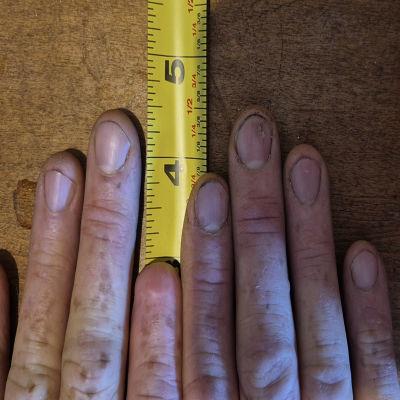
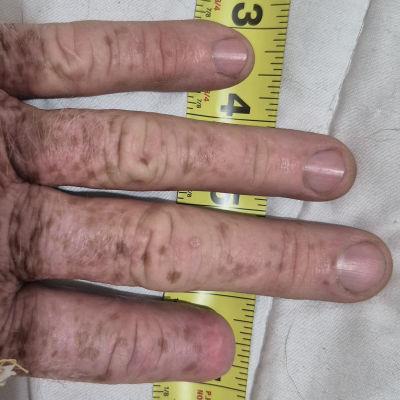
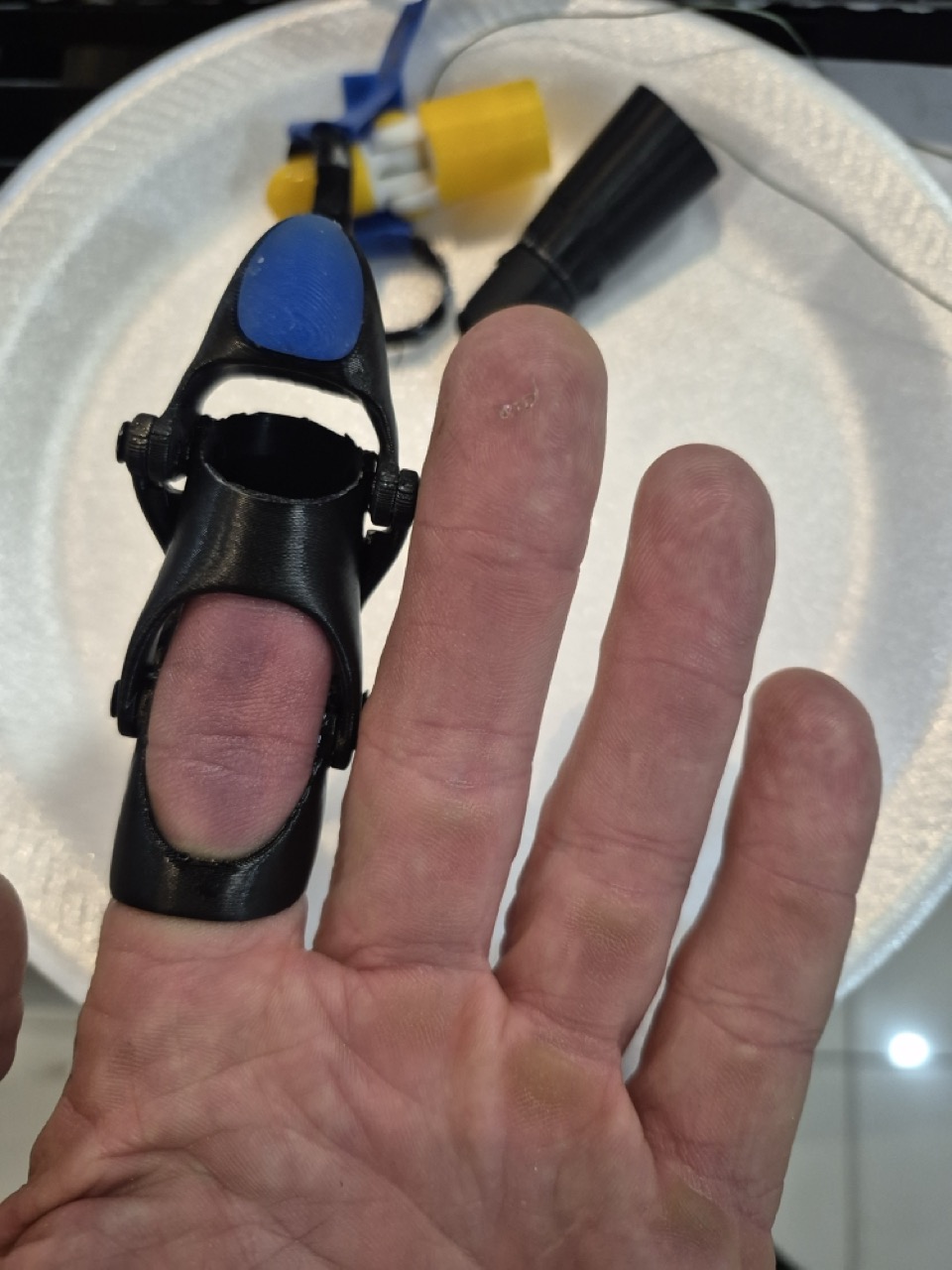
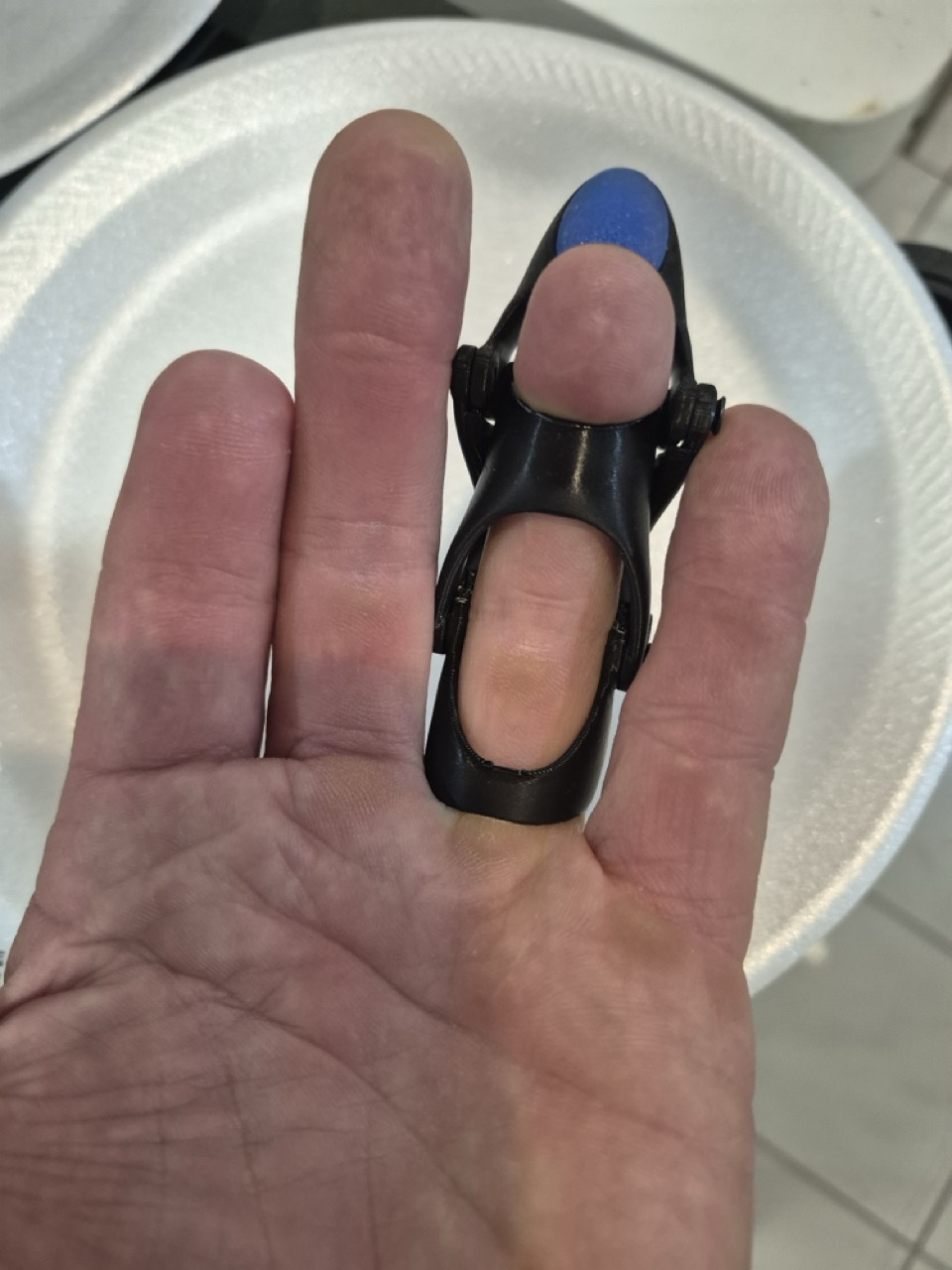
I printed three versions for the first shipment: a Knick Finger, a Kinetic Finger with a hinge, and a stringless gravity-actuated design. The stringless one was the best fit for S.P.'s case. From there, the build became a back-and-forth: each iteration addressed something specific that S.P. had measured and described. The proximal opening was too tight on the first batch, so he tested it on his ring finger instead. Then the overall length needed to come down by about 1 cm to match his intact finger. Then the width at 115% was slightly loose, so we tried 110% and 105% as comparisons. S.P. gave detailed feedback after every version.
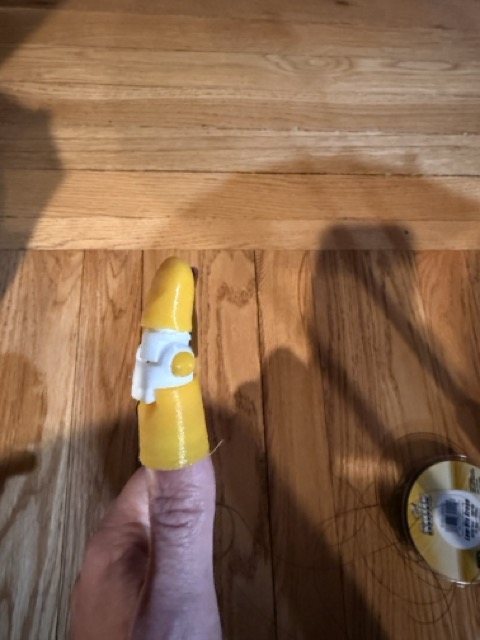
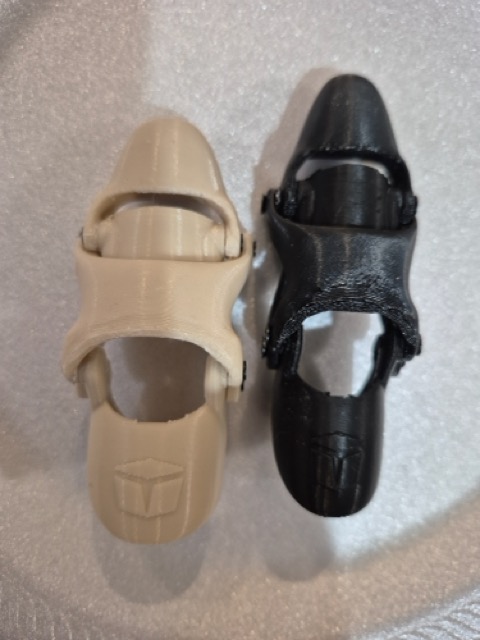
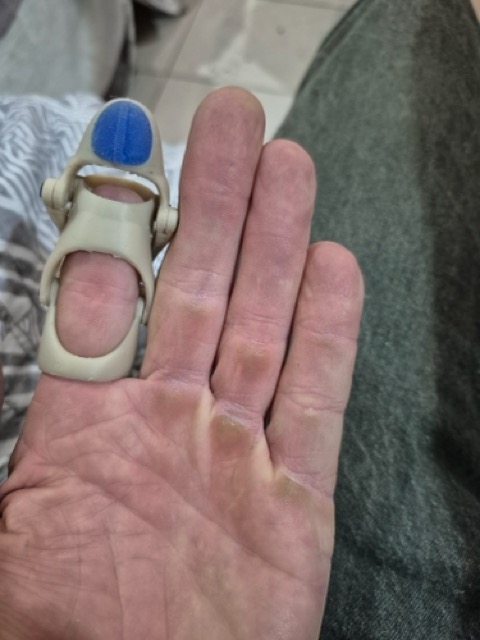
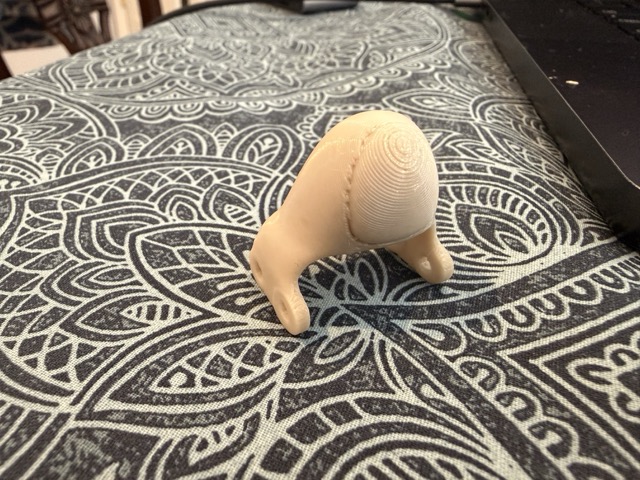
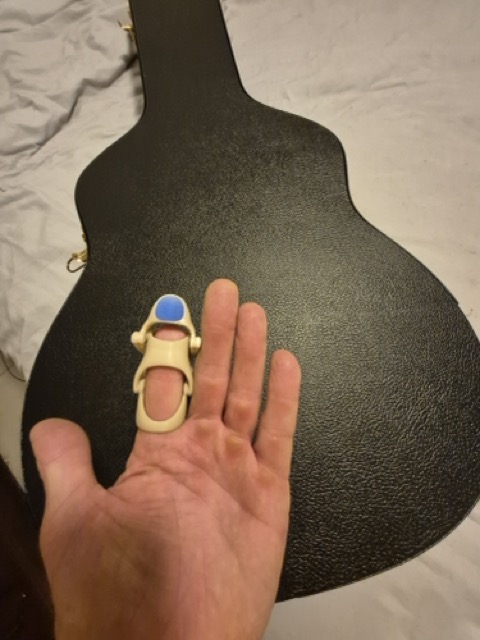
The final device is the stringless gravity-actuated prosthetic, beige PLA+, printed at 115% width and 90% of the original length. It requires no tension cord and no wrist attachment. The remaining knuckle movement guides the hinge naturally. A blue silicone grip pad at the fingertip provided the tactile contact for pressing strings. I later sent a separate solid plastic tip, since guitar strings would eventually cut through silicone. S.P. is a general contractor and shaped it himself to find the right seating on the fretboard.
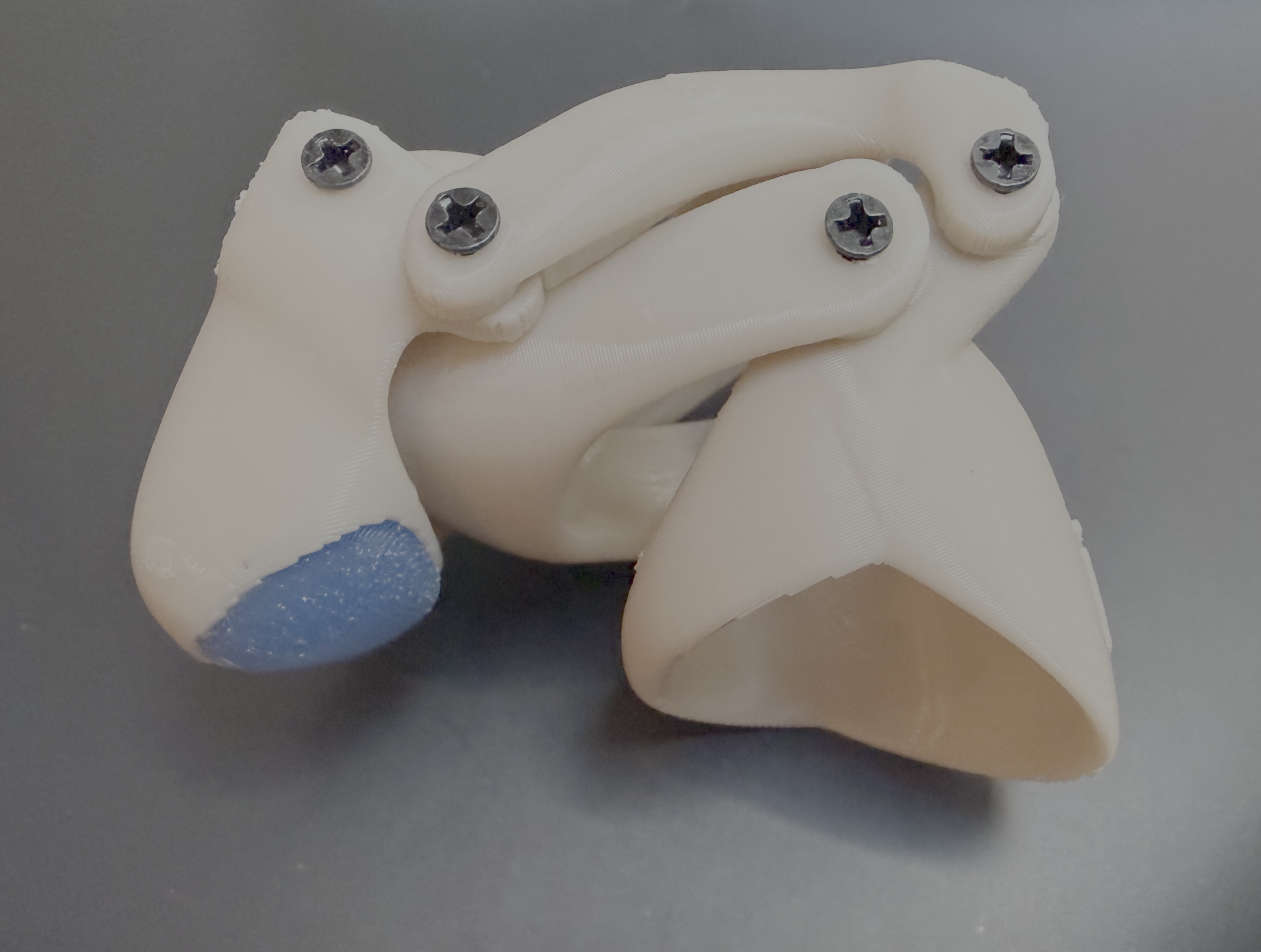
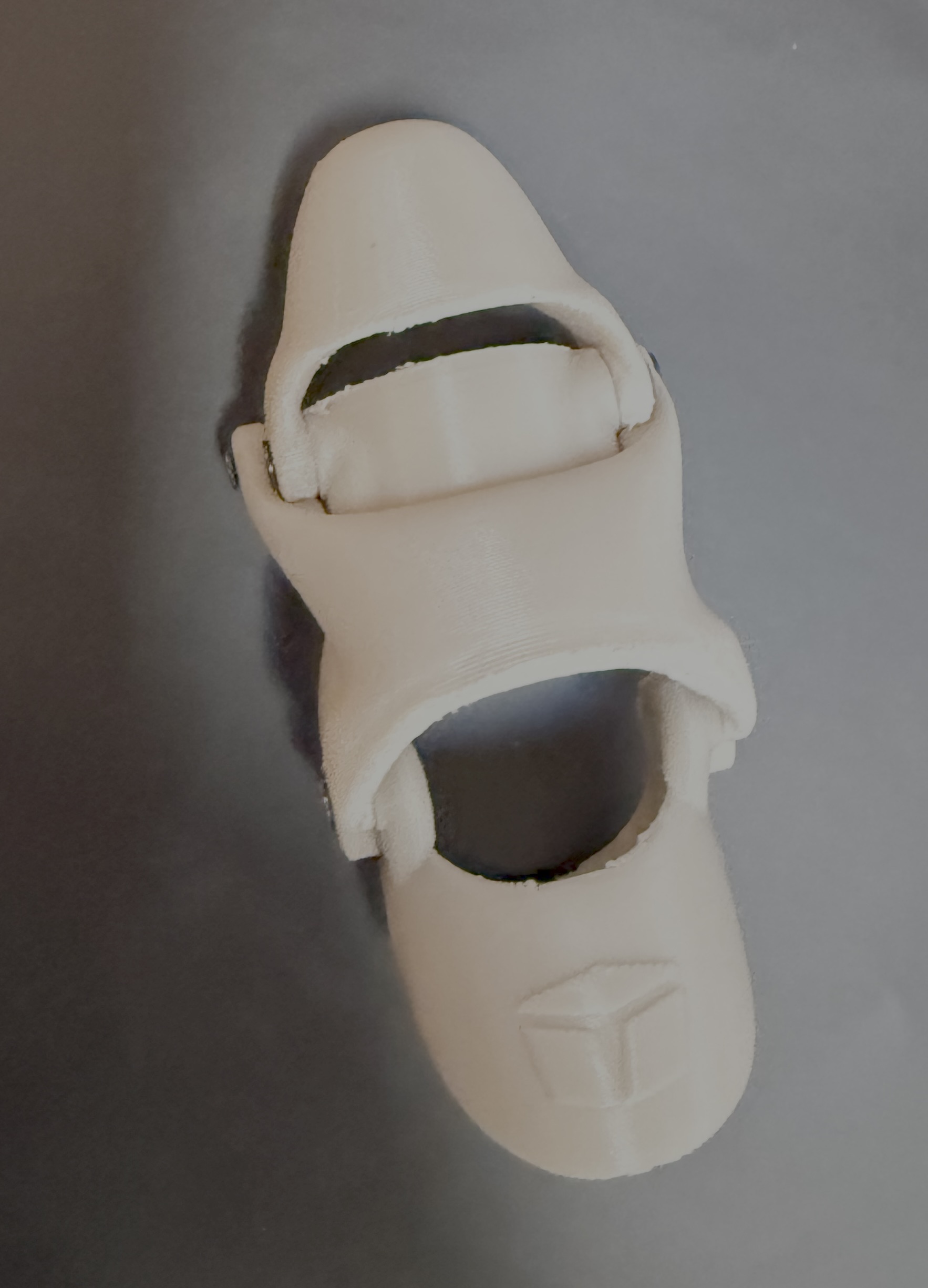
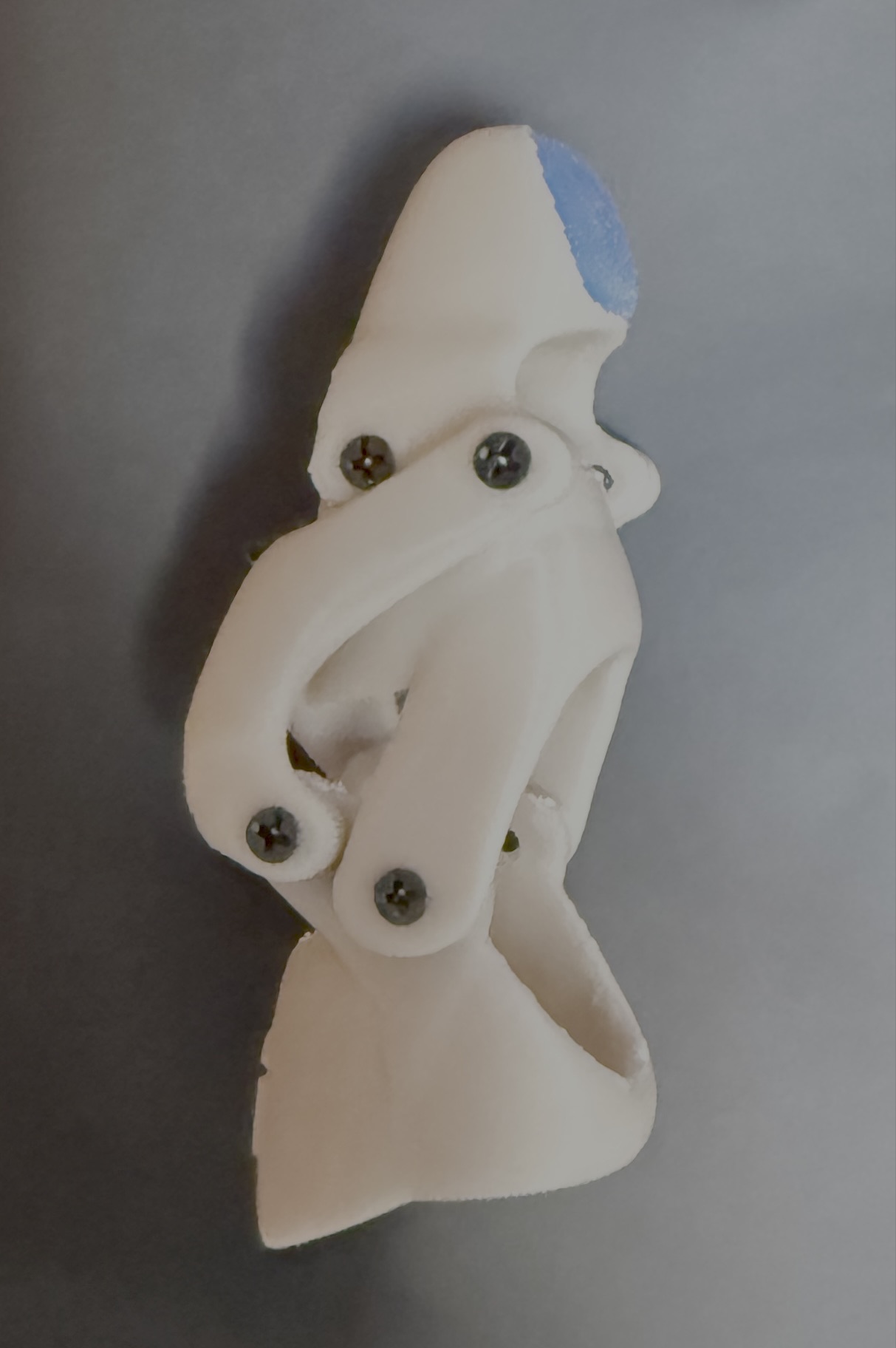
Gravity CAD Distal Finger Prosthetic · Beige PLA+ · Left index finger
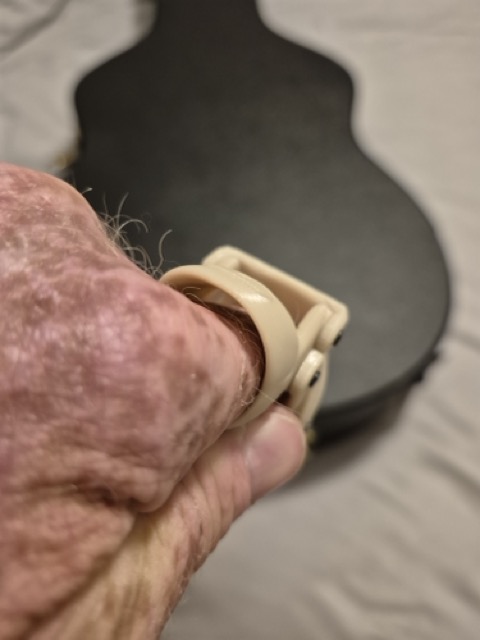
On January 20, 2026, S.P. received the latest iteration in the mail. He put it on immediately and went to the guitar. He sent a message in all capitals: "I WAS ABLE TO STRUM A C AND G CHORD."
By February 9th, he was wearing the device at work. He's a general contractor who uses a computer keyboard and found it helped there too. He wrote to say he was still experimenting with hand positions on the guitar and figuring out how to shape the distal tip for the best string contact.
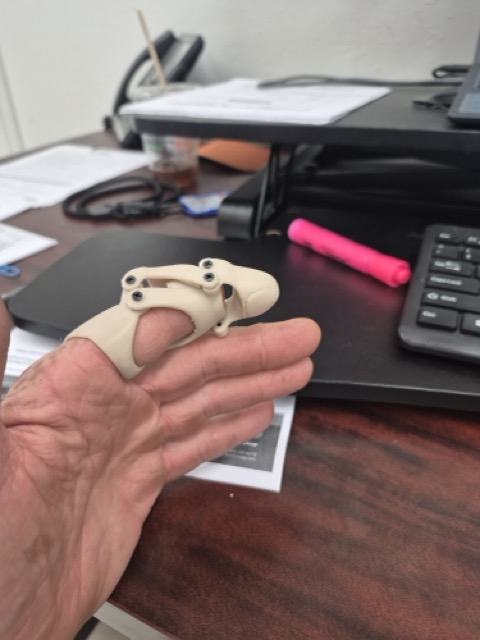
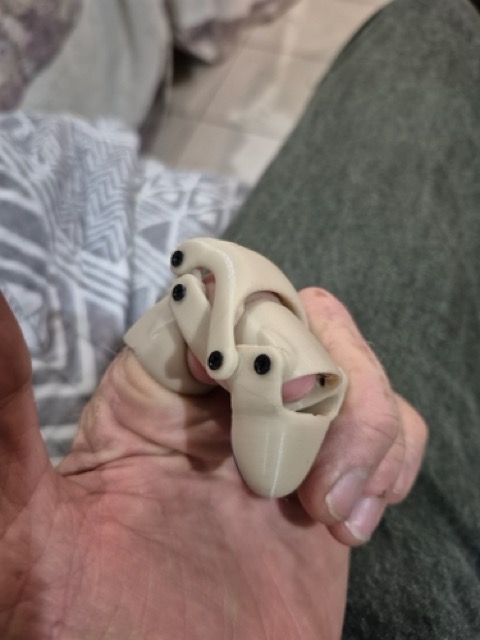
The solid plastic distal tip was sent in February to replace the silicone version. S.P. mentioned that guitar strings would cut through silicone over time, so a full plastic tip made more sense for long-term use. He planned to shape it himself once he figured out exactly where the finger needs to sit on the strings.
He also mentioned a guitar forum online where many players have the same issue, losing a fingertip and not being able to find an affordable solution. He said he was going to post there about how his search ended.
Most of my cases go overseas. My first US recipient was Leon from Georgia — but that case was unsuccessful. Mikey from Nevada was my first successful US arm case. S.P. was different from both: a finger prosthetic, for an adult in Florida, someone who could have theoretically been at any orthotics office within driving distance, and still ended up with nothing for almost a year.
The $11,000 quote. The workers' comp pipeline. The device from California that did not move. The epoxy idea. He had been so close to giving up. What struck me was how carefully he communicated throughout the whole process, every measurement precise, every piece of feedback specific and patient. He made it easy to keep going.
I haven't trusted a lot of people in my life, but you have shown me differently. When I began receiving your messages, it gave me hope. The accident happened the second week of February. My birthday is February 1st. I became depressed because the music and the guitar is my stress reliever and harmony. You are good people.
S.P. · Fort Lauderdale, Florida · January 2026